Find the structure.
Build what comes next.
Strategy, analysis, systems, and execution for consequential problems that don't arrive neatly organized.
Find the structure.
Build what comes next.
Strategy, analysis, systems, and execution for consequential problems that don't arrive neatly organized.

When to Bring Me In
I help leaders and teams make sense of complex situations, resolve dilemmas, and build what's missing. You don't need more ideas; you need clarity, alignment, and forward progress.

Unclear What's Really Going On
The situation is complex, options are everywhere, and no one can agree on the real problem.

No Clear Path Forward
You know you need to act, but the options are confusing, risky, or politically difficult.

Stakeholders Aren't Aligned
Teams, partners, or executives have different priorities, assumptions, or definitions of success.

Critical Piece or Capability Missing
You have part of what you need, but some essential structure, skill, system, or process isn't in place.

High Stakes, High Risk Decision
The decision matters greatly, the risks are significant, and getting it wrong could be costly.

Strategy Needs Execution
You have the plan, but execution is stalling, fragmented, or not delivering results.

I bring clarity to complexity, alignment to teams, and structure to action, so you can move forward with confidence and build what comes next.
Working in Three Dimensions
Organization. Transformation. Human Agency.
Dilemmatician applies three complementary frameworks to work through complex problems. Used together or individually, they bring order to your organization, define the transformation you’re seeking, and account for the complex human agency through which change actually occurs. They clarify what is happening, what must change, and what can be built or done to move forward.
The Organizational Saga
Whether they come from the classroom or the bestseller list, business books are full of useful models and frameworks for positioning, customers, finance, operations, teams, competitive strategy, experimentation, and growth. What they rarely provide is the higher-order structure: which tool matters now, how the pieces fit together, and what will change elsewhere when one part of the organization changes.
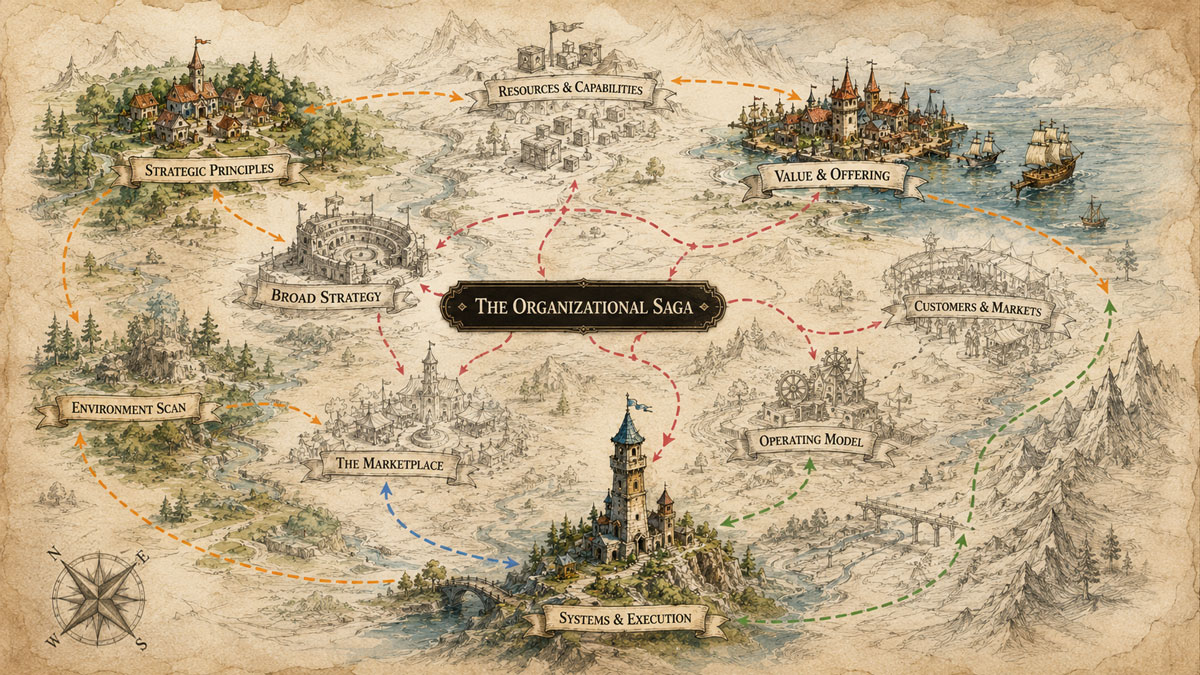
Marketing strategy, sales strategy, operating structure, competitive strategy, and execution may all be sound in isolation, yet the whole may lack coherence. The Organizational Saga treats the organization instead as an unfolding story — a connected system with a starting condition, resources, actors, choices, constraints, and direction, all in an environment that reacts back. The Saga integrates established strategic and organizational tools into a larger structure, with new connective tools where the existing ones leave gaps.
A strategy may originate with something distinctive you can offer, targeted customers whose needs you seek to fill, or a particular market or channel you are unusually well-equipped to reach. The Organizational Saga begins with the essentials, tests assumptions, and iterates outward through increasingly detailed strategic loops while repeatedly bringing those dimensions back into alignment. If you are already well into your organization's story or have urgent challenges, you can start where you are, fill in missing details with “flashbacks,” and keep moving forward.

The Transformation Architecture
The Transformation Architecture started as a wish for a way to “time warp” to a world in which a project was already done, a needed tool already built, or the stars already aligned. The question was whether we could systematically understand how things change and identify the structure of transformation so we could move through reality more directly, eliminating unnecessary intermediate steps and processes.
The Architecture begins by describing the Current State and Desired State with enough precision that the gaps between them become visible. Those gaps imply transformation vectors: changes in capability, knowledge, decisions, relationships, behavior, position, access, or other conditions that would make the Desired State more probable.
This shifts the focus beyond merely getting things done. A report, model, agreement, system, or campaign is not ultimately the purpose. Rather, the value of such deliverables lies in how they change what you can know, decide, do, access, or sustain. The true objective is the changed state in which the options you want have become available.
Execution systems, such as 4DX or any other preferred approach, can guide implementation, but the Transformation Architecture sits one level higher: identifying what must change, what structures or actions can create that change, and how to move from the Current State to the Desired State as directly and effectively as reality allows.

The Discernment Model
The Discernment Model is unique among Dilemmatician’s core frameworks in that its design wasn’t rooted in a desire to solve a particular problem or traverse a particular gap. It grew from a desire to understand reality, and that inquiry naturally has practical applications.
The model’s essential insight is that action takes place among possibilities and within relationships. Each person brings multiple internal perspectives to a situation; when people interact, those perspectives influence which possibilities become real; and every choice is constrained by what reality permits.
The Discernment Model incorporates intelligence modes, emotional relevance, relational roles, and internal perspectives without reducing people to personality types or communication styles. In practice, it helps identify hidden assumptions, competing perspectives, emotional pressures, and points of misalignment that may be shaping decisions or blocking progress.
Its deeper purpose is to help us understand what the world is showing us, why we and others are responding as we are, and how choices can be framed to move relationships and organizations toward more productive shared realities.

From RFP Rescue to Repeatable Bid Engine
Multi-year engagement with a 160-year-old national maritime transportation company
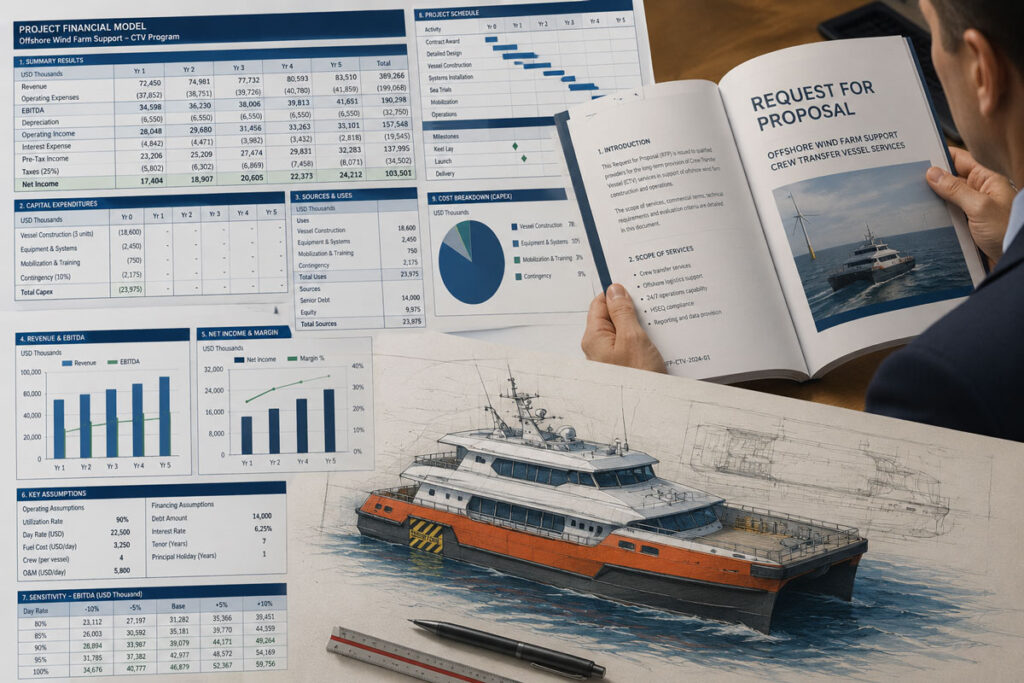
Initially brought in to help rescue a major RFP response approaching deadline, I developed the work into a reusable bid-development system deployed across six major and multiple smaller proposals. The resulting architecture combined proposal production, project control, and a multi-sheet financial model spanning construction, operations, financing, taxes, projections, and termination scenarios, while making the company’s capabilities easier to present coherently across projects and subsidiaries.
Read case study
From RFP Rescue to Repeatable Bid Engine
The Situation
An executive at a 160-year-old maritime transportation company was pursuing offshore-wind opportunities that represented a meaningful evolution in how the company would combine and present long-established capabilities. The underlying relationships, operating knowledge, and maritime experience were not new, but they had to be assembled in unfamiliar ways for a different subindustry and a different kind of commercial pursuit.
I entered through another industry consultant to help salvage a major RFP response that was rapidly approaching deadline. The immediate need was better writing, production discipline, and clear ownership of the final submission. As the work progressed, however, it became clear that the proposal problem could not be separated from deeper questions of pricing, financing, capability definition, and internal coordination.
What Made It Difficult
The bid drew information from multiple people, subsidiaries, project phases, and internal processes, much of it informal or distributed across the organization. The initiative was being championed primarily by one executive and had not yet developed broad internal alignment, while the external deadline left little room for a slow discovery process.
The proposal also had to make a persuasive case that experience accumulated in adjacent maritime work could credibly support a new class of opportunity. Pricing added another layer: construction costs, operating assumptions, financing, taxes, required returns, projections, and termination scenarios all had to be made explicit and reconciled in a model that could survive repeated revision.
How the Work Evolved
My role began with writing, document production, tracking, and project management. As each layer of the immediate problem exposed the next governing constraint, the engagement expanded into proposal architecture, financial modeling, spreadsheet automation, executive communications, presentation development, and ownership of final deliverables.
Rather than impose a generic proposal or financial-planning system, I worked from the client’s existing practices, preferences, and ways of reasoning, then built additional structure around them. That approach made it possible to improve the work without requiring the organization to adopt an entirely new operating language before it could act.
What We Built
The engagement produced a reusable bid-development infrastructure rather than a single proposal: modular production templates, reusable narrative and qualifications material, production tracking and project-control practices, internal branding and presentation materials, and a multi-sheet financial model that could be adapted across opportunities and subsidiaries. The system was ultimately used for six major RFP responses and multiple smaller bids, including opportunities outside offshore wind.
What Changed for the Client
The reusable architecture reduced the amount of work required to begin each new response and made it practical to pursue opportunities the company might otherwise have passed over. It also gave the executive leading the effort a more sophisticated platform for discussing pricing, project economics, and proposal strategy with internal stakeholders and prospective investment partners.
Just as important, the financial model converted implicit assumptions into explicit variables. It showed where traditional approaches to vessel financing, required returns, and pricing could make bids structurally uncompetitive in some emerging markets. In that sense, the model did more than calculate a price: it clarified what deeper financial or organizational conditions would have to change for desired outcomes to become attainable.
What This Demonstrates
A bounded production problem can reveal a deeper systems problem. In this engagement, improving a proposal exposed the need for better project control; better project control exposed the need for a reusable bid architecture; pricing exposed financing assumptions; and the model ultimately surfaced organizational constraints beyond the original assignment.
That progression reflects a recurring Dilemmatician pattern: start with the consequential problem in front of the client, locate it within the larger organizational story, build what is missing, and follow the problem only as deeply as the situation requires. The result may be a stronger deliverable, a reusable capability, clearer strategic information, or a newly visible constraint that the organization must address before further progress is possible.

Turning Generations of Experience into a Winning Proposal
First-time competitive RFP for a multigenerational U.S. Virgin Islands ferry operator
A long-established ferry operator had never before needed to translate generations of operating experience, community history, and institutional knowledge into a formal competitive proposal. I reconstructed that story through interviews and research, converted the government’s requirements into a controlled workplan, and wrote and produced the complete technical and persuasive response, which won the contract.
Read case study

Turning Generations of Experience into a Winning Proposal
The Situation
A multigenerational ferry company in the U.S. Virgin Islands had spent decades serving an essential transportation role through longstanding relationships, inherited practices, and deep community familiarity. Government modernization was changing how that role had to be secured. Instead of relying on arrangements and shared knowledge accumulated over generations, the company now had to compete through a formal RFP it had never undertaken.
The company regarded the award as crucial to its continued viability. Yet much of what made it valuable was tacit rather than documented. Its history existed largely as family and island lore; its community contribution had never been organized into a business narrative; and management’s future plans had not yet been fully formalized.
What Made It Difficult
The challenge was not simply to write a compliant proposal. A modern procurement process could no longer rely on shared community memory to make the company’s value obvious. Decades of practical knowledge, public-service history, operating capability, and local significance had to be made explicit and presented in terms relevant to contemporary decision makers.
That meant translating formal RFP requirements, tacit operational knowledge, future plans, company history, community anecdotes, and likely evaluator incentives into one coherent response. The work also carried real stakes for a client with no prior RFP process or reusable proposal infrastructure.
How the Work Came Together
I decomposed the RFP into requirements, tasks, and document ownership then interviewed relevant personnel to understand the company’s programs, services, operating practices, plans, and community role. I supplemented those interviews with independent research into the ferry service, the islands, and the company’s history, looking for facts and stories that could make longstanding value legible within a modern procurement process.
The research surfaced unusually rich material: the founder’s role in developing dedicated inter-island ferry service, the family’s part in establishing the public ferry franchise, a dock bearing the founder’s name, and a territorial commemoration tied to a later family episode. These were useful not as nostalgia, but as evidence that the company’s identity and capabilities were intertwined with the transportation system the government sought to modernize. I then wrote, designed, and produced the complete response, including custom graphics and narrative material connecting past performance with the proposed future service.
What We Built
The immediate product was a complete, submit-ready proposal, including the complete narrative and financial proposal. The engagement also left the company with a reusable body of institutional narrative and capability material describing its history, community role, operating record, services, and future direction — content that could support future bids, marketing, and other situations in which its value needed to be explained beyond the circle of people who already knew it.
What Changed for the Client
The client won the RFP. Just as importantly for future opportunities, it emerged from the process with first-hand experience of competitive procurement, a successful proposal as a precedent, and reusable content and graphics for communicating capabilities that had previously existed mainly in practice and memory.
The proposal also reframed modernization as continuity rather than rupture. It connected a larger new vessel, added capacity, and economic development to the company’s multigenerational role in expanding reliable inter-island transportation — arguing that the government’s next stage could build on an institution already woven into island life.
What This Demonstrates
Not every engagement requires following a problem deep into organizational fault lines. Sometimes the valuable work is to uncover what an organization already possesses, identify what matters to the audience making the decision, and give that substance a form the outside world can recognize and act on.
This engagement required rapid immersion, structured interviewing, research, audience and incentive analysis, project control, persuasive and technical writing, graphic production, and ownership of the finished submission. It is a compact example of a recurring Dilemmatician function: find the structure hidden inside tacit or distributed information, make its relevance explicit, and build the instrument the situation requires.

Bringing Structure to an Eight-Figure Company Sale
Information architecture, transaction analysis, and closing coordination for the eight-figure sale of an established, multi-entity home inspection company
Managed the information architecture and closing workflow for the eight-figure sale of an established home inspection company, coordinating contracts, disclosures, assets, staged payments, approvals, and document control across multiple entities. Working alongside seller’s counsel, I performed substantive contract and financial analysis across successive agreement drafts, surfacing provisions that departed from negotiated terms or introduced additional risk while the transaction moved through closing without last-minute process problems.
Read case study

Bringing Structure to an Eight-Figure Company Sale
The Situation
An experienced real-estate company that regularly acquired businesses sought to purchase an established home inspection company for more than $30 million. The buyer arrived with a mature, standardized acquisition process built from repeated transactions and, naturally, structured around its own requirements and interests. For the seller, this was a singular event in which the details of a complicated operating business had to remain visible and controlled while moving through the buyer’s machinery.
The seller’s company used multiple legal entities and a large network of independent contractors operating under several generations of agreement templates. The consideration also involved staged payments to multiple recipients and purchases of stock in the buyer by the seller and some employees. The transaction therefore had to be understood simultaneously as a legal structure, a financial arrangement, an operating-business transition, a sequence of closing obligations, and a business exit for our client.
What Made It Difficult
Subtle differences among contractor agreements mattered because provisions accumulated across multiple versions could affect representations, obligations, and disclosure requirements. The company’s multi-entity structure added another layer, as assets, contracts, payments, and responsibilities had to be traced to the correct parties rather than treated as though the business were a single undifferentiated entity.
The purchase agreement itself evolved through roughly half a dozen drafts. Successive versions sometimes altered provisions that had already been negotiated, changed economic effects, or introduced additional legal and financial risk. That made version control more than a clerical concern: the team had to know what had changed, what those changes meant elsewhere in the deal, and whether the latest documents still reflected the business understanding the parties believed they had reached.
How the Work Came Together
I worked alongside the seller’s corporate counsel and the client to build a working model of the transaction. I reviewed the company’s existing contracts and assets, mapped the entities and deal structure, modeled the staged payment schedule and recipients, and managed document collection, data-room submissions, approvals, and closing requirements.
I also performed substantive analysis of the transaction documents, reviewing defined terms, cross-document dependencies, financial provisions, and changing agreement language at a high level of detail. When successive drafts conflicted with negotiated features or introduced new risks, I identified the issue, explained its practical and economic implications to the client and counsel, and contributed to the strategy for resolving it. After closing, I continued to track time-sensitive obligations so the client would not lose sight of requirements that survived the sale.
What We Built
The engagement produced a working transaction architecture: deal and entity diagrams, a detailed financial and payment model, organized data-room and disclosure submissions, asset-status tracking, document and version control, closing-task and approval tracking, a controlled set of final transaction documents, and a closing record that could be used to verify what had been completed and what obligations remained afterward.
What Changed for the Client
The transaction closed for the agreed consideration without last-minute document or process problems. The client moved through a buyer-controlled acquisition process with a parallel structure that kept the seller’s contracts, economics, negotiated protections, approvals, and obligations legible as the deal changed around them.
The resulting architecture reduced the risk that important details would disappear inside the transaction’s complexity. The client and legal team could see how entities, money, contracts, assets, tasks, and deadlines fit together, and where a change in one part created consequences elsewhere.
What This Demonstrates
A high-stakes transaction can become too interconnected to hold comfortably in any one person’s head. In this case, the buyer already had an acquisition machine; the seller needed an equally coherent way to make its own business and negotiated position visible while moving through that machine. Information architecture turned a changing collection of documents, entities, payments, and deadlines into a controllable system.
The engagement required contract interpretation, financial modeling, business-structure analysis, closing control, and clear communication with the client and counsel. It illustrates a recurring Dilemmatician function: view the same problem through several professional lenses, find conflicts or gaps, and build the structure that lets consequential work proceed with fewer surprises.

Turning Founder-Led Growth into an Operating System
Multi-year embedded engagement helping a founder-led digital agency formalize its customer lifecycle, operating roles, contracts, technology, personnel systems, and strategic direction.
Entered through an immediate need to strengthen client contracts as increasingly complex projects produced more disputes, then followed the underlying problems into sales, project delivery, personnel, technology, and strategy. Mapped the organization, automated commercial processes, redesigned ownership and handoffs across the customer lifecycle, and helped build an operating structure that allowed employees and contractors to take greater responsibility while the founders continued pursuing ambitious opportunities.
Read case study

Turning Founder-Led Growth into an Operating System
The Situation
The engagement began with a concrete problem: A digital agency was taking on increasingly valuable and complicated work, and the resulting client disputes had exposed weaknesses in its contracts. I joined the company’s corporate attorney in formalizing a stronger client agreement and building a more-efficient, field-based system for sales personnel to implement it.
The contractual problem, however, was only one symptom of a larger organizational challenge.
The founders were unusually effective at selling ambitious work and rapidly assembling globally distributed talent around new opportunities. That entrepreneurial responsiveness had helped create the company, but the operating structure behind it had developed more informally. Roles, tools, project ownership, client communication, and delivery processes had accumulated as needs arose rather than as parts of a deliberate system.
The challenge was therefore not to replace an entrepreneurial culture with bureaucracy. It was to build enough structure behind its strengths that the rest of the organization could reliably carry what the founders were capable of selling.
What Made It Difficult
The agency delivered a wide variety of work — from photography and conventional websites to copywriting and increasingly sophisticated web applications — using personnel distributed across four continents. Technology platforms had accumulated through individual preferences and immediate needs, while formal titles, practical responsibilities, and lines of authority did not always correspond neatly.
Most important, operational responsibility remained highly concentrated at the top. When a client problem or project question did not have an obvious owner, work could stall, fall between roles, or escalate unnecessarily to the founders.
That made individual problems difficult to solve in isolation. A better contract implicated the sales process. Sales implicated handoffs. Handoffs implicated project management, quality control, personnel roles, and technology. Each improvement had to fit the way the founders and existing team actually worked while making the organization less dependent on constant executive intervention.
How the Work Evolved
My initial work stayed close to the sales process. I helped make the new client contract modular and field-driven through PandaDoc, reorganized the company’s Close.com CRM, trained the existing sales team, and increasingly handled larger, more complex, and RFP-driven prospects myself.
The founders and I then mapped the company’s full operating system — people, functions, workflows, and relationships. That exercise made a recurring source of client difficulty clearer: task ownership, communication authority, project handoffs, and quality-control responsibility were not sufficiently explicit.
I helped redesign the customer lifecycle around two complementary roles. Account executives would remain advocates for the client relationship from the original sale through post-project follow-up, while project managers would assume primary responsibility for production during the engagement. Choreographed kickoff and wrap-up meetings made those transitions explicit rather than informal.
As the system took hold, my role continued to expand into areas without a natural internal owner: personnel and contractor agreements, onboarding, technology-stack analysis, data and archive migrations, client instructional materials, sales training, and other cross-functional projects.The engagement ultimately reached the company’s broader strategy. Along with its corporate attorney, I led a multi-day retreat structured around the Organizational Saga, using a large printed map of the framework to help the founders examine the business as one connected system and clarify what each was ultimately trying to build.
What We Built
Rather than one central deliverable, the engagement produced an increasingly explicit operating architecture, including:
- A mapped view of the company’s functions and workflows
- A standardized client-contract structure and automated PandaDoc process
- A more-organized and -automated CRM and sales pipeline
- Defined account-executive and project-management roles
- Formal kickoff, handoff, wrap-up, and follow-up processes
- Clearer ownership and escalation paths
- Contractor agreements and onboarding processes
- Technology-stack analysis and system migrations
- Sales and RFP practices and training
- A structured process for companywide strategic planning
The point was not merely to document what the company did. It was to make its operating logic visible enough that people other than the founders could understand it, assume responsibility within it, and improve it.
What Changed for the Client
The clearest changes appeared in ordinary organizational behavior.
Account executives embraced responsibility for the client relationship, while project managers began taking genuine ownership of delivery. In some cases, the two groups coordinated directly to resolve client problems rather than escalating them upward.
Meetings that had frequently jumped among unresolved issues became more focused and often shorter. Some recurring discussions could eventually be removed from the founders’ calendars because the team had enough structure and authority to answer questions without them.
A lead project manager grew into a larger leadership role, and the clearer operating structure made it easier to integrate new personnel. By the later stages of the engagement, some of the people responsible for the redesigned processes were operating them independently enough that my own involvement in day-to-day management was becoming less necessary.
The agency was also pursuing and winning larger, more-demanding projects, including complicated RFP-driven work. The operating changes did not resolve every constraint in the business, but they gave the organization a substantially clearer structure with which to confront its next ones.
What This Demonstrates
Rapidly moving entrepreneurial organizations rarely lack energy or ideas. Their strengths can themselves create the next problem: opportunities multiply faster than roles, systems, and decision structures evolve to support them.
This engagement illustrates a recurring Dilemmatician pattern. Start with the problem that is producing pain now, but do not assume that its visible form defines its actual depth. A contract problem may be partly a workflow problem; a workflow problem may be an ownership problem; an ownership problem may require changes in roles, technology, incentives, or strategy.
The objective is not to impose a generic management system. It is to understand what already makes the organization effective, build coherent structure around those strengths, and enable more of the organization to carry responsibility for what comes next.

Turning a Policy Idea into a Model, Legislation, and Campaign
Policy-design and advocacy engagement for the Rhode Island Center for Freedom & Prosperity, combining economic modeling, legislative drafting, research, visualization, and campaign strategy.
Expanded a relatively simple academic voucher model into RI-DIMES, a detailed Rhode Island-specific tool for projecting the enrollment and fiscal effects of school-choice legislation statewide and by school district. Used the model not only to explain the proposal, but to refine the policy itself, heavily revise draft legislation, produce district-level reports and graphics, and support a public and legislative campaign that secured sponsorship, hearings, and serious policy attention.
Read case study

Turning a Policy Idea into a Model, Legislation, and Campaign
The Situation
State-based policy organizations often begin with national research or models that can be adapted relatively quickly to local conditions. The Rhode Island Center for Freedom & Prosperity had such a starting point for a proposed educational-scholarship program: a relatively straightforward spreadsheet co-created by Providence College economist Angela Dills that used an elasticity assumption to estimate participation and fiscal effects.
The immediate opportunity was to use that work to support a Rhode Island school-choice proposal. But the policy problem was more demanding than a statewide estimate. Rhode Island’s school districts differed in enrollment, revenue sources, cost structures, local tax support, and access to private-school capacity. A proposal that looked reasonable in the aggregate still had to be defensible district by district and flexible enough to answer practical questions about scholarship amounts, eligibility, phase-in, and likely participation.
The political environment raised the stakes. School-choice legislation was a longshot in Rhode Island, so the case could not depend on a generic claim that choice would save money. The policy needed a mechanism that could survive scrutiny and a way to show legislators what the proposal would mean for the communities they represented.
What Made It Difficult
I had not previously built a model of this complexity. Once I understood the underlying calculation, however, it became clear that the original spreadsheet could support a much richer structure.
The challenge was to reduce reliance on broad assumptions by incorporating actual Rhode Island information while keeping the model flexible enough to test policy choices. That meant gathering public- and private-school enrollment and location data, distinguishing among fixed costs, per-student variable costs, and threshold costs such as classrooms or buildings, and researching how quickly private schools could plausibly expand through representative surveys and interviews.
The policy itself also had to remain adjustable. Scholarship amounts, eligible uses, whether participation was limited to students leaving public schools or extended more broadly, cost thresholds, participation assumptions, phase-in, and other provisions all affected the projected fiscal result. The model therefore had to function not merely as a calculator, but as a working policy-development environment.
How the Work Evolved
I expanded the spreadsheet into what became the Rhode Island District Impact Model for Educational Scholarships, or RI-DIMES. The Excel model separated major categories of information across worksheets, incorporated actual enrollment and school-capacity data, exposed important assumptions as adjustable inputs, and generated district-specific reports with charts and graphics.
As the model became more capable, the project changed from a relatively formulaic think-tank report into a much more integrated policy effort. RI-DIMES could test alternative designs before they were turned into public claims. When an all-in version of the policy produced costs that were obviously politically unrealistic, I adjusted the proposed program and continued modeling until the near-term fiscal effects were within a tolerable range while preserving the potential for families to add new private spending to the overall pool of educational resources.
The model then became part of the legislative process itself. Starting from draft language supplied by national school-choice partners, I heavily revised the legislation for Rhode Island and adjusted policy provisions in part based on what RI-DIMES revealed.
The same analytical structure then fed the communications and advocacy work. I helped plan the campaign, produced district-by-district graphics and supporting research, prepared explanatory materials, testified on the proposal, and participated in a meeting with the Speaker of the House’s relevant research and policy staff, who described the model as “very impressive.”
What We Built
The project ultimately produced an integrated policy-development and advocacy architecture rather than a single report:
- RI-DIMES, an interactive Excel model projecting enrollment and fiscal effects statewide and by school district
- A richer Rhode Island-specific evidence base incorporating actual public- and private-school data, cost behavior, and private-school growth capacity
- Adjustable policy scenarios that allowed scholarship amounts, eligibility, participation, cost thresholds, phase-in, and other assumptions to be tested before adoption
- Heavily revised legislative language tailored to Rhode Island’s political and fiscal conditions
- District-level reports, charts, graphics, and explanatory research for legislators and the public
- Testimony, briefing materials, and analytical support for legislative meetings and hearings
- Campaign strategy and communications materials supporting the broader school-choice initiative
The model did not simply produce the answer we wanted but analyzed district-by-district Unified Chart of Account data according to multiple cost scenarios and chose the most pessimistic. Where individual districts produced less favorable results, those results remained part of the analysis. The purpose was to understand the consequences of the policy well enough to improve it and defend it, not to reverse-engineer universal positive outcomes.
What Changed for the Client
The legislation did not ultimately pass. In Rhode Island, a proposal of this kind would likely have required a sustained, multiyear political effort, and the Center did not have the long-term funding and allied infrastructure necessary to keep the campaign growing until the political conditions changed.
Even so, the work moved the proposal well beyond the level of an abstract policy preference. It produced credible legislation, legislative sponsorship and hearings, public discussion, and a level of analytical detail that removed many of the easiest fiscal objections from the debate.
The project also changed the Center’s own capabilities. It moved more strongly toward original research customized to Rhode Island rather than relying primarily on adaptations of national work, and developed substantially greater credibility for its in-house analysis. RI-DIMES became evidence that a small policy organization could build sophisticated, locally grounded tools rather than merely comment on research produced elsewhere.
What This Demonstrates
The engagement began with a bounded assignment and a useful, but relatively simple, analytical structure. Once I understood how it worked, I saw that the real opportunity was much larger: build a model capable of representing the local system more faithfully, use it to improve the policy rather than merely justify it, translate the resulting structure into legislation, and then convert the analysis again into forms that legislators and the public could use.
That required moving across disciplines that are often separated: economic modeling, data collection, policy design, legislative drafting, visual communication, testimony, and campaign strategy. The value did not lie in any one spreadsheet, bill, graphic, or hearing. Those were intervening structures in an effort to move an idea from abstract preference toward institutional reality.
The project also demonstrated a limit that later became important to my thinking about transformation. A technically credible model, carefully engineered policy, strong communications, and legislative access do not guarantee that a desired state will come into existence. Political change also requires durable relationships, resources, incentives, and infrastructure capable of sustaining the effort long enough for the environment to become receptive.
Taking Ownership of a Multimillion-Dollar Custom Build
Early-career construction leadership on a highly customized Newport mansion renovation and major addition, coordinating as many as 25–30 tradespeople and specialists while serving as the main onsite link among client, architect, engineer, inspectors, and contractor.
Entered construction at 29 with essentially no trade experience and, roughly two years later, unexpectedly found myself running a multimillion-dollar custom project after more-experienced foremen were reassigned elsewhere. Built my own project-management and document-control systems, coordinated changing plans and a wide range of trades and specialists, solved continual field problems, and helped carry the project through while the family continued using the property.
Read case study
Taking Ownership of a Multimillion-Dollar Custom Build
The Situation
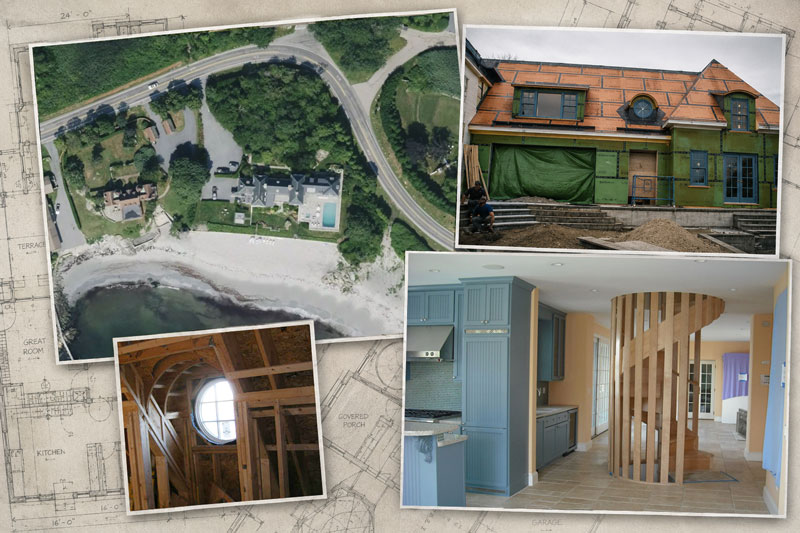
Near Sea, a beachfront mansion on Newport’s Ocean Drive, felt like an entire construction career compressed into less than two years. The budget was large, the materials and features were unusually custom, and practically every phase introduced unfamiliar decisions that could not be resolved simply by following standard practice.
I had entered construction at 29 with essentially no practical trade experience. Within a few years I had progressed from basic labor to carpentry, troubleshooting, and occasional crew leadership, in part because I had become useful when more-experienced tradespeople encountered problems that did not yield easily to experience alone.
Near Sea unfolded in phases. After helping with demolition and initial framing for a major renovation and new pool-house wing, I remained on as an analytical assistant to the framing foreman. By the time the project reached unusually complicated roof framing—angles, arches, circular windows, dormers, and changing architectural details—the company needed its other foremen elsewhere. At about 32 years old, with roughly two years of construction experience, I unexpectedly found myself running the job.
What Made It Difficult
The project combined the normal complexity of a multimillion-dollar renovation with a huge number of custom conditions, moving parts, and changing plans. The second phase was still underway when the owners returned for the summer, so the job had to keep advancing while substantial portions of the property remained safe, usable, and presentable for the family.
On busy days I was coordinating roughly 25–30 people across my own crew and multiple trades and specialties: plumbing, electrical, masonry, tile, painting, pool systems, slate roofing, HVAC, stucco, cabinetry, counters, steam room and sauna installations, and other custom work. I was also the principal onsite connection among the contractor, client, architect, engineer, groundskeeping staff, inspectors, and specialty vendors.
The project could not be managed according to one simple organizing principle. Sometimes the governing priority was a room that had to be ready for summer occupancy; sometimes it was a difficult-to-schedule subcontractor; sometimes materials, inspections, utilities, or an architectural dependency controlled the sequence. Organizing by room, person, phase, material, trade, or building system each revealed something important, but none of those structures could dominate the others.
As responsibility shifted toward me, practical authority sometimes moved faster than formal titles. People increasingly looked to me for direction, which meant that keeping the work moving also required judgment about communication, responsibility, and lines of authority.
How the Work Evolved
Once I realized I was effectively responsible for the project, I sat down and built an Excel-based management plan despite having no formal project-management background. I also created a filing and tracking system for the many layers of architectural and construction drawings, which changed repeatedly as the client, architect, engineer, and field conditions interacted.
The work became an early lesson in what I would now call multi-axis project planning: keeping multiple valid structures visible at once and continually deciding which one governed the next action. The system was not sophisticated by later standards, but it gave me a way to impose enough order on the job to coordinate work, identify dependencies, and keep changing information from disappearing into the complexity.
I was also unusually aggressive, for the period, about using technology to shorten feedback loops. I carried an early camera-equipped smartphone with a slide-out keyboard. When field conditions showed that the drawings could not work as shown—for example, when roof lines failed to meet as expected—I could photograph the actual condition, email it directly to the architect, and receive the image back with a solution drawn over it. That allowed design and construction to stay connected without waiting for the next site visit.
The project generated continual practical puzzles. After winter, water began flowing down the underlying stone ledge and entering the future wine cellar beneath the foundation, forcing an improvised drainage solution. At the base of the new three-story spiral stair, I milled a one-piece synthetic-wood ring, built a curved tube of paneling on it, constructed a curved custom door from matching material, and coordinated with a blacksmith to create braces and hardware capable of making the design functional.
What Was Built
The physical scope under my foremanship eventually covered much of the property, including:
- Completion and punch-list work in the earlier children’s and staff quarters, including multiple bedrooms, bathrooms, storage areas, and finish details
- Major renovation of the existing mansion, including portions of the kitchen and dining areas, the ballroom, television room, guest suites, master suite, steam room, sauna, windows, trim, and hidden systems
- Construction of the new pool-house wing, including a guest suite, billiard room, living area, kitchen, guest bath, three-story spiral stair, wine-cellar area, and associated basement work
- Supervision of the swimming pool, outdoor kitchen, pool-equipment areas, and related concrete and specialty systems
- Renovation of a large porch and patio area and substantial utility upgrades and redesign
- Extensive custom architectural work using unusual materials and hand-milled woodworking, including the curved stair enclosure and door
Alongside the building itself, I had effectively built an operating system for the project: a planning structure, drawing-control process, communication loop, and practical method for reconciling the competing priorities of trades, spaces, systems, materials, schedules, and people.
What Changed for the Client
There was no single conventional deadline on a project this customized, but the milestones that mattered were met. The family was able to return for two consecutive summers and safely enjoy substantial portions of the property while work continued, and the relationship remained strong through the long finishing stages rather than deteriorating into the familiar end-of-project pressure to get the construction team out.
The finished work substantially expanded and upgraded an already exceptional property, and the client subsequently recommended the builder for additional projects at neighboring family properties.
The project also helped move the construction company into a higher tier of residential work. The company owner later credited my management of Near Sea as important to his ability to handle a new level of project complexity and quality, and the firm went on to win more spectacular high-end mansion work.
What This Demonstrates
Near Sea is where the operating pattern that later became central to Dilemmatician work is visible long before I had a name or formal frameworks for it. The project could not be solved by knowing one trade particularly well. It required understanding enough of the whole system to see how many specialties, schedules, physical constraints, human relationships, and design intentions affected one another.
The response was the same one I would later bring to strategy, transactions, modeling, and organizational work: learn unfamiliar domains quickly, construct a system when none exists, keep multiple competing structures visible at once, use technology to shorten feedback loops, coordinate specialists without becoming trapped inside any one specialty, and exercise judgment when the plan stops matching reality.
It also makes the word, “builder,” literal before it becomes metaphorical. The objective was never a plan, spreadsheet, meeting, or drawing. Those were useful only insofar as they helped turn a changing and complicated set of possibilities into a finished physical reality.
How It Comes Together
Across construction, research, production, and consulting, employers and clients trust me to fill emerging gaps. As my responsibilities expanded, I absorbed a distinctive, integrated set of capabilities.

Execution
Construction leadership taught me practical judgment about sequencing, resources, quality, accountability, and the difference between plans and workable plans.

Analysis
Technology-market editing, policy research, MBA study, and financial modeling fostered my ability to interrogate assumptions, compare scenarios, and understand unfamiliar industries quickly.

Communication
Publishing, editing, design, media, and public affairs developed my talent for turning specialized information into clear, credible material for different audiences.

Integration
Consulting brought these disciplines together in projects requiring one person to understand problems holistically and construct missing instruments.

Fault-Line Management
Work on core strategies and high-stakes projects sharpened my judgment in recognizing conflicts over ownership, authority, incentives, and alignment, clarifying underlying issues, and keeping difficult situations oriented toward decisions and action.
Thanks to my experience, many of your problems will be familiar. But together, we can solve the dilemmas that arise from what makes you unique.
Tell me where you are in your dilemma.